


TL;DR By chapter twenty, most writers are losing track of their characters. This guide gives you a complete system to track every character, every detail, and every relationship so your story stays consistent from chapter one to the end. |
The bigger your cast gets, the more your story starts working against you.
Not because the writing is bad. Because the human brain was not built to hold forty people, their histories, their relationships, and every detail you assigned them across a year of writing sessions.
Something will fall through the cracks. The only question is whether you find it before your readers do.
Most writers only start thinking about how to keep track of characters in a novel after something has already gone wrong. A beta reader flags a contradiction. A character shows up alive after dying three chapters ago. A relationship that was hostile in chapter four is suddenly warm in chapter nine with no explanation.
Setting up a system before that happens is one of the best investments of time you can make in your story.
Why Writers Lose Track of Their Characters
Think about a novel like Fourth Wing. Rebecca Yarros is managing Violet, Xaden, an entire war college full of riders, multiple dragon bonds, a political rebellion, and a cast of supporting characters whose loyalties shift across the whole book.
Each of those characters has a look, a history, a relationship with Violet that changes as the story moves. Each has information they know and information they do not. Getting any of that wrong would break the reader's trust instantly.
Most writers do not start with a cast that complex. But the cast grows. Side characters show up. Each one gets details assigned in the moment, a name, a look, a reason for being in the scene. None of it gets written down because it feels obvious at the time.
By chapter fifteen, there are twelve named characters. Between writing sessions, small things get forgotten. Then bigger things.
This is not about how good your memory is. It is about what happens when a story grows faster than any single person can hold it.
The writers who stay consistent across long drafts are not the ones with better memories. They are the ones who stopped relying on memory early enough.
Not All Characters Need the Same System
Most character tracking advice treats every character the same. Build a profile, fill in the details, done.
But Feyre in ACOTAR needs a very different level of detail than the Suriel, who appears in a handful of scenes. Treating them the same wastes time and creates systems writers abandon by chapter ten.
Split your characters into three tiers:
Tier 1: Main Characters
Your protagonists and anyone who drives the plot forward. Full profile. Physical details, backstory, what they want, how they speak, their key relationships, and a chapter-by-chapter appearance log. In Fourth Wing, this is Violet, Xaden, Rhiannon, Liam, and the other core riders.
Tier 2: Supporting Characters
Characters who appear in multiple scenes and have a real impact on the story. Shorter profile. Name, appearance, role, what they want, and who they are connected to. In ACOTAR, this is Lucien, Alis, the other High Lords who show up in Amarantha's court.
Tier 3: Background Characters
Named characters who appear briefly. A guard, a messenger, someone in one scene. All you need is their name, one physical detail, and which chapter they appear in. Enough to stay consistent if they ever come back.
This alone cuts the work of character tracking in half.
What to Track for Each Character
Within each tier, here is what actually matters:
Name and Appearance
Full name, age, and every physical detail you mention in the text. Hair, eyes, height, scars, how they dress. Sarah J. Maas keeps Rhysand's violet eyes and Illyrian tattoos consistent across thousands of pages and multiple books. That does not happen by accident.
Their Role
Friend, enemy, mentor, rival. One sentence is enough. This stops you from writing them out of character when they reappear after a long gap.
What They Want
Every character wants something, even minor ones. Knowing this makes their behavior feel consistent every time they appear. Xaden's motivations in Fourth Wing are layered and specific. Every scene he is in makes sense because Yarros knew exactly what he wanted and what he was protecting.
How They Speak
Almost no one tracks this and it causes real problems. Rhysand speaks differently from Cassian. Violet speaks differently from Xaden. Word choices, sentence length, whether they use humor as armor, whether they go quiet when they are angry. Voice is as important as appearance for consistency and just as easy to forget across a long draft.
Their History With Other Characters
Who do they know? Who do they have tension with? Who do they owe something to? In ACOTAR, almost every relationship in the Spring Court carries weight from before the book even starts. Tamlin and Rhysand's history. Lucien and Amarantha. Maas tracked all of this so that when it surfaces in the story, it feels earned rather than invented on the spot.
Where They Appear
Chapter number and a one line note about the scene. This is your appearance log. When you need to check when two characters last interacted, this saves you from searching your whole manuscript.
How They Change
Note which chapter a major shift happened and what changed. Feyre's arc across ACOTAR is one of the most carefully tracked character journeys in recent fantasy. Every stage of her change is marked by a specific moment. That level of precision is possible when you are logging it as you write, not trying to reconstruct it in revision.
Three Ways to Build the System
The Notebook Method
One notebook, one page per character.
Write the name at the top. Add the basics, their role, and a note about where they first appear. Every time a scene adds a new detail, flip to their page and write it down.
This works for small casts. At twenty characters it starts to break down. You are flipping constantly and losing time you should be spending writing.
It also gives you no way to see how characters connect to each other, which is where the harder problems live.
The Spreadsheet Method
One row per character. One column per detail. Name, age, appearance, first chapter, role, notes.
This scales better. Writers who build it out properly often create multiple tabs for characters, locations, and timelines. It is searchable and fast to scan.
The problem is that spreadsheets live outside your manuscript. You have to remember to update it after every session. Most writers do not. By chapter twenty the spreadsheet is three chapters behind and half the cells are empty.
It is also flat. There is no way to see relationships between characters or how those relationships change as the story moves forward.
The Dedicated Tool Method
This is where the problems the first two cannot solve actually get addressed.
Dedicated tools like Writeo keep character profiles, chapter-by-chapter appearance logs, and relationship mapping all inside the same place you are writing. There is no separate document to maintain.
When something changes in chapter seventeen, you log it right there in the same session.
The relationship map is what makes the biggest difference for writers with larger casts. Every character appears on a visual map with their connections drawn between them. You can see the whole social structure of your story at once and update it as things change.
Tracking Characters Is Only Half the Job
Most character tracking focuses on individual characters.
That is useful but it only covers half the problem.
Consider the relationship web in A Court of Mist and Fury. Feyre, Rhysand, the Inner Circle, the Court of Nightmares, Hybern, Tamlin. Each relationship carries its own history, power dynamic, and emotional charge. Some are shifting in real time. Some are not what they appear to be.
A list of individual character profiles does not show you any of that. You end up cross referencing multiple documents and still not feeling certain you have it right.
A visual relationship map changes this. Instead of holding all of it in your head, you can see the whole picture at once. Who knows whom. What the nature of each relationship is. How it has changed across the story.
But seeing the relationships is only part of it. The harder thing is tracking how they change.
Xaden and Violet start as enemies in Fourth Wing. By the end they are something else entirely. Every step of that shift happened across specific scenes, specific chapters, specific moments. If you are writing an arc like that, you need to be able to log each shift as it happens, not reconstruct it in revision.
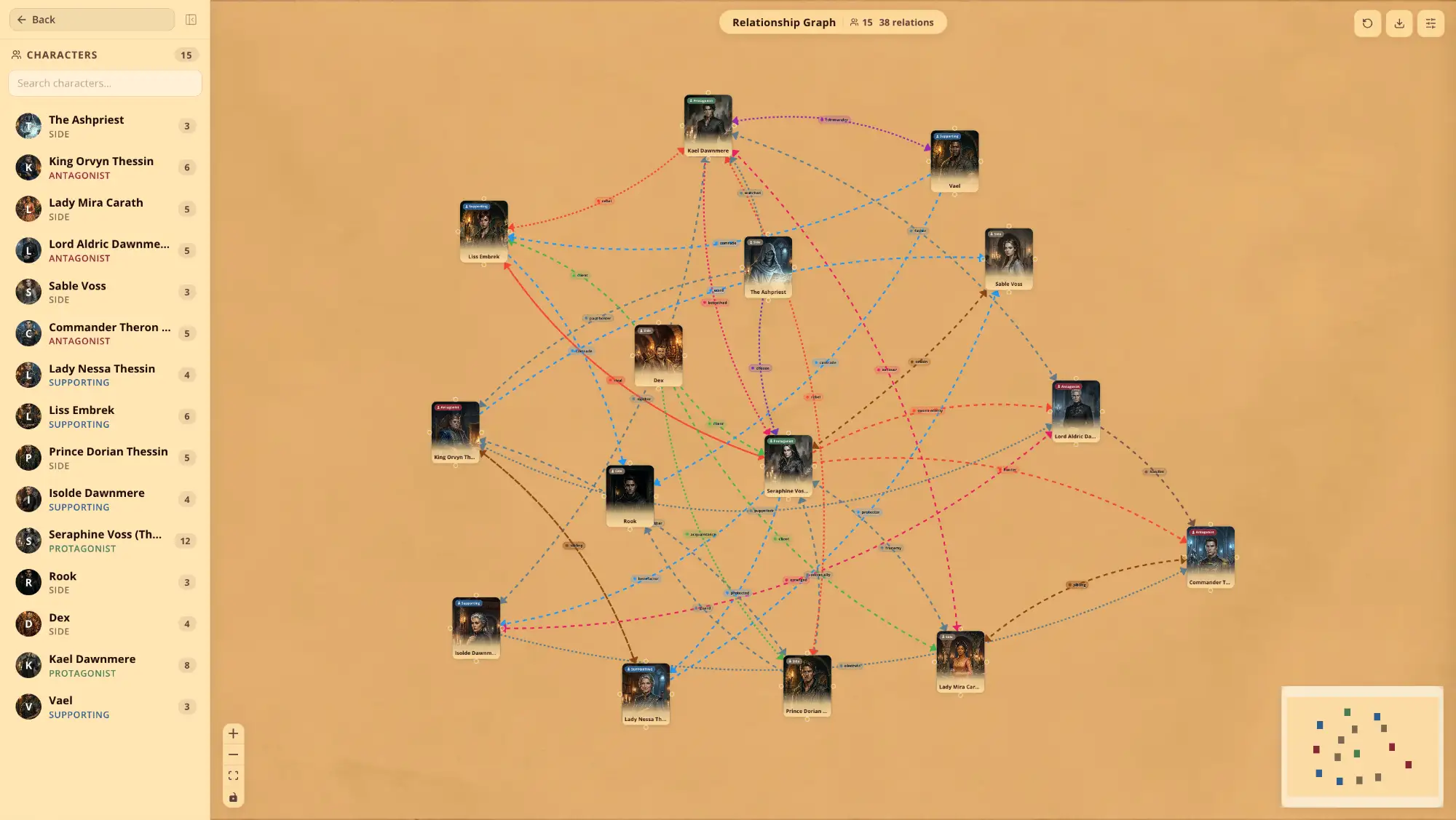
The WriteO relationship graph for a fantasy novel
What to Do If You Are Already Mid-Draft
If you are already twenty or thirty thousand words in with no system, do not try to go back and read everything from the beginning. That takes days and pulls you out of your writing momentum.
Here is a faster way to build the system without stopping:
Start With Your Main Characters Only
Open a new document and fill in what you already know about each of them. Name, appearance, what they want, their key relationships. This takes less than an hour and covers the characters where mistakes matter most.
Add to It as You Write Forward
Every time a new scene introduces or changes a detail, add it to the profile. You are not reconstructing the past. You are capturing the present and moving forward.
Spot Check the Details That Feel Shaky
If you are not sure when two characters last interacted, do a quick search of your manuscript for those specific things. Fix them, then add them to the profile so you never have to search again.
Leave Background Characters for Later
Add them to your tracking system only when they reappear. If they never come back, you do not need a profile for them at all.
Within a week of writing this way, you will have a working system without having stopped to read your whole manuscript back.
The Consistency Checklist Before You Share Your Draft
Before you send your manuscript to a beta reader or editor, run through this for your main characters:
Appearance
Is hair color consistent throughout?
Are eye color and height mentioned the same way every time?
Do any physical details change without explanation?
Voice
Does each character speak in the same way throughout?
Are verbal habits or word choices consistent?
Could you tell who is speaking without looking at the dialogue tags?
Relationships
Does each character treat the others consistently with their established history?
Do any relationships shift without a scene to explain it?
Is there a scene where two characters who have not met seem to already know each other?
Timeline
Does each character appear in the right chapters given where they are in the story?
Is there any scene where a character is in two places at once?
Do any characters know information they should not have been given yet?
Arc
Does each main character end the story in a different place from where they started?
Is there a scene that marks each major change?
Does the change feel earned given what happened before it?
Running through this before anyone else reads your manuscript will catch most of what editors flag in first drafts.
A Simple Character Sheet to Get Started
Copy this for each character:
Character Sheet Name: Tier: (Main / Supporting / Background) Age: Appearance: (everything you mention in the text) How they speak: (formal, casual, short sentences, any verbal habits) Role in the story: What they want: First appears: Chapter ___, Scene ___ Key relationships: (who they know and how) Chapter appearances: (log each chapter they appear in) How they change: (note the chapter when something important happens) |
Fill it in the first time each character appears. Update it when details change. If your cast is growing complex, check out how to organize characters in a novel for a deeper guide.
Tip If you are starting a new novel, spend thirty minutes setting up your character tracking system before you write chapter one. It takes almost no time upfront and saves hours of searching later. |
How Writeo Handles This
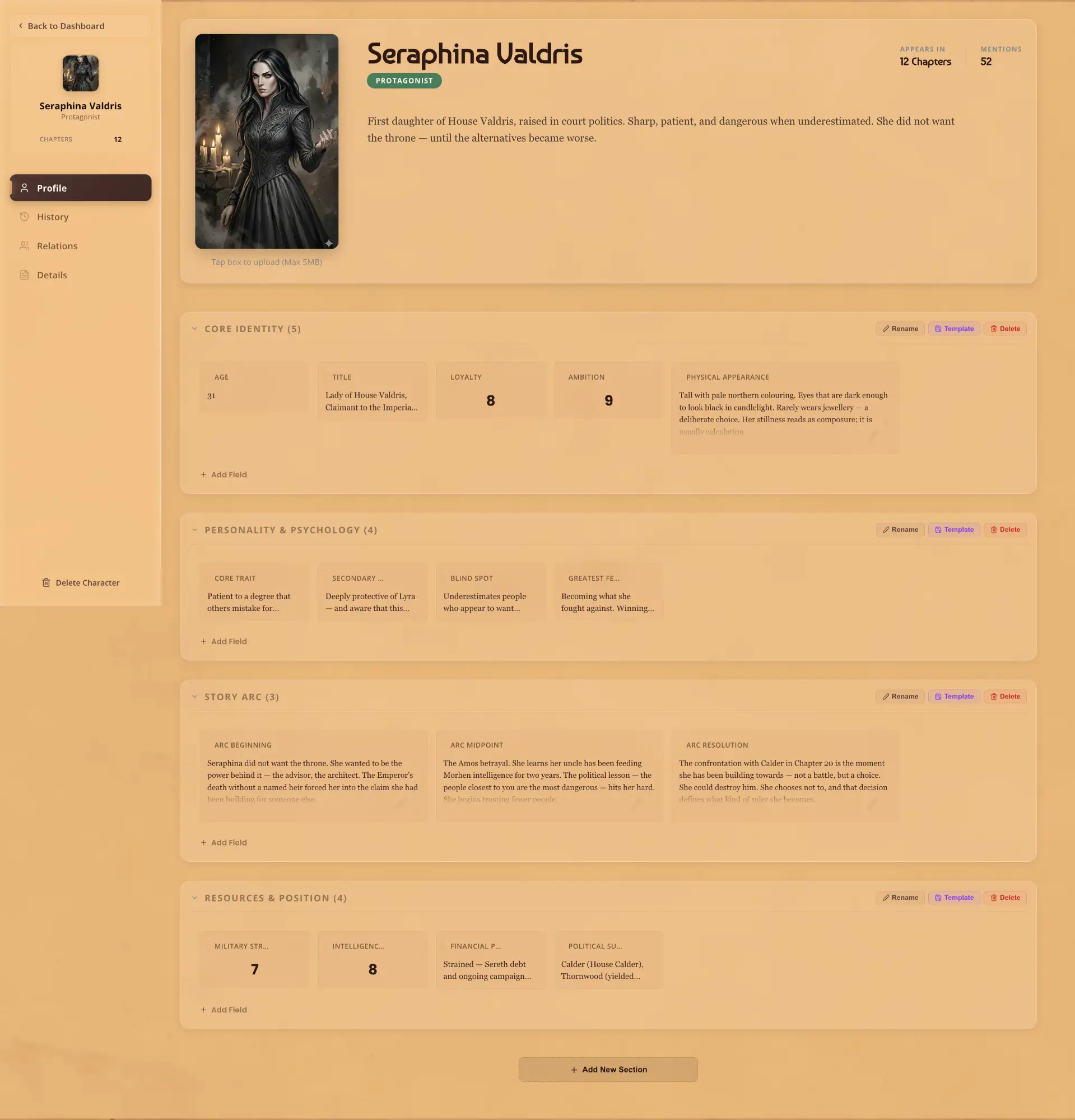
A full character profile in WriteO with custom sections for a main character
Every character gets a full profile with appearance, backstory, personality, and chapter-by-chapter appearance tracking. The profile above shows what this looks like in practice. Core Identity, Personality and Psychology, Story Arc, Resources and Position. Every field you need, right next to your manuscript.
Writeo comes with pre-built character profile templates so you are not starting from scratch every time. There is already a structure waiting when you add a new character.
You can also build your own templates and reuse them across your whole novel. One template for main characters with every field you need. A shorter one for supporting characters. A quick one for background characters with just the basics. Set it up once and apply it every time. No rebuilding the same structure over and over.
As you write, the tool tracks which chapters each character appears in and builds a running history across your whole manuscript.
The Character Relationship Visualizer puts every character on an interactive map with their connections drawn between them. Each relationship has a type, an intensity level from 1 to 10, and a full evolution log.
When a relationship changes in your story, you use the Evolve Relationship feature. You record what the relationship was before, what it changed to, how intense it now is, which chapter it happened in, and the reason behind it. Every change gets stored in the Relationship Timeline so you can see the full history of how two characters got from where they started to where they ended up.
For an arc like Xaden and Violet's in Fourth Wing, or Rhysand and Feyre's in ACOTAR, this is the feature that keeps every beat of that journey documented and findable.
Everything is inside the same tool you write in. No switching apps. No separate spreadsheet to maintain.
The free tier covers two novels and fifty chapters. Start free at writeo.app.
Stop Overthinking the Tools
Pick a method that fits where you are right now.
Small cast, simple story: the character sheet above is enough.
Growing cast, more moving parts: move to a spreadsheet or a dedicated tool.
Large cast, fantasy or epic fiction, relationships that shift across the story: a visual relationship map is worth setting up before things get complicated.
Whatever you choose, your manuscript should never be your character reference system. Searching through 80,000 words to check a detail is one of the most frustrating ways to spend a writing session.
Set something up and it stops being a problem.