


|
Brandon Sanderson's Stormlight Archive spans four published books, hundreds of named characters, and a magic system precise enough that readers have published academic analyses of how it works.
He does not hold all of that in his head.
Neither does Sarah J. Maas. Neither does Rebecca Yarros. Every writer working at that scale maintains some version of the same tool: a story bible. A single place where every established fact about their world lives, searchable and findable in seconds.
You do not need to be writing a ten-book epic to need one. You need it the moment your story becomes too complex to hold entirely in your head. For most writers, that happens earlier than they expect.
What a Story Bible Actually Is
A story bible is a living reference document for your fictional world.
Not an outline. Not a character list. Not a mood board. All of those things can live inside it, but the bible itself is something more specific. It is the single source of truth for every fact you have committed to on the page.
Your protagonist's eye color. The rules of your magic system. The name of the city your characters are traveling to and how far it is from the last one. The political structure of the kingdom. Anything you have written in your manuscript and might need to check again later.
The idea came from screenwriting, where teams of writers work on the same show across multiple seasons. They needed a shared document so that a writer joining in season three would know everything established in season one. Fiction writers borrowed the concept because they ran into the same problem solo: memory is not reliable across a year-long draft.
A story bible does not make you a better writer. It makes your story more consistent. Those are different things and both matter.
What Actually Goes Wrong Without One
The problems are quieter than you expect. A character's scar moves from the left cheek to the right between chapters. A city that was three days ride away is suddenly one. A character who was not in the room somehow knows what was said there. None of it is dramatic. All of it pulls readers out of the story.
Here is what this looks like in practice:
World Rules Stop Holding
You established in chapter five that magic drains the user physically. In chapter nineteen your character casts three spells back to back with no consequence. The rule got forgotten in the gap between writing sessions. Readers who are paying attention will notice before you do.
Timeline Errors Stack Up
Two characters are in different cities on the same day. An event that happened six months ago gets referenced as happening three months ago. These are almost impossible to catch in revision without a timeline you built as you wrote. By the time you find them, fixing one often breaks something else.
Terminology Drifts
The made-up city was spelled one way in chapter three and a different way in chapter seventeen. The character's title changed between the first mention and the fifth. These feel like small things until a reader points them out in a review.
Series Continuity Breaks
If you are writing a series, everything you publish in book one becomes a constraint on book two. A throwaway detail about a character's dead sister. The distance between two cities. A character's age at a specific point in the story. It is all in print. Readers remember it even when you do not.
Plotters and Pantsers Need Different Story Bibles
A plotter and a pantser are not just writing differently. They are using the story bible differently. If you try to build the same kind of bible for both, one of them ends up with something that does not fit how they actually work.
If You Are a Plotter
You build the bible before you write. Your world rules, character profiles, and timeline are established in the planning phase. The bible is your foundation. When you sit down to write chapter one, you already know what it says.
Your main job during drafting is to update it when the story changes. Because it will. Characters do things you did not predict. New details get invented in the moment. Log them. The bible you built in planning needs to reflect the story you are actually writing, not the one you planned.
If You Are a Pantser
You discover your world as you write it. Which means the bible is not a foundation. It is a record.
Every time you invent a detail in a scene, you write it down immediately. The character's name. The color of the building. The way the magic worked in that moment. You are not planning, you are documenting. The bible is the only place these things live before you have a finished draft to search.
This is actually more important for pantsers than plotters. A plotter who forgets to update their bible can check their outline. A pantser who forgets has no backup.
What Goes Inside
A story bible is not the same length for every novel. A standalone contemporary romance needs a much leaner document than a six-book epic fantasy. Here is how to think about it:
For a Standalone Novel
Keep it focused on the things you are most likely to forget or contradict.
Characters. Name, age, appearance, role in the story, what they want, and how they speak. For main characters, add a short arc summary. For supporting characters, the basics are enough. For background characters, just a name and one detail. See our guide on how to organize characters in a novel for a deeper look at this.
The world. Whatever makes your setting unique and whatever rules govern it. If it is contemporary fiction set in a real city, this section is short. If it is secondary world fantasy with its own political systems and magic, this section needs real depth.
Timeline. The sequence of events in your story world. When things happened. How much time passes between chapters. This is the section that prevents the most embarrassing errors in revision.
Terminology. Any made-up words, place names, or spellings specific to your world. Consistent spelling of invented names across 200,000 words does not happen by accident.
For a Series
Everything above, plus two things most writers do not think about until book two:
A working bible and a published canon bible. Your working bible is updated freely during drafting and can contain speculative notes, ideas you are considering, things that might change. Your published canon bible is updated only after a book is finalized and in print. It contains only what is established fact. Keep them separate. Mixing them is how series writers lose track of what is actually canonical.
Reader-facing continuity. Everything a reader could look up. Everything referenced in a published book that could appear in a fan wiki. The published canon bible exists to protect you from contradicting yourself across books that are years apart in the writing.
The Five Minute Rule
This is the habit that separates story bibles that get used from ones that sit in a folder and never get opened.
Every time you finish a writing session, spend five minutes updating the bible.
Not an hour. Not a full review. Five minutes. Did you introduce a new character? Add their name and one detail. Did you establish a new world rule? Write it down. Did something happen that changes the timeline? Log it.
Five minutes at the end of every session keeps the bible current. Skipping it for three sessions in a row and then trying to catch up costs an afternoon.
The writers who actually use their story bibles are not more disciplined. They just made the update habit small enough that skipping it feels harder than doing it.
|
Where It Lives Matters More Than How It Is Organized
A story bible that requires you to open a separate app, switch windows, or search through a physical binder will not get updated regularly. The friction is too high. You are writing, you invent a detail, you think you will log it later, and you do not.
Separate app or physical binder. Highest friction. Works for some disciplined writers. Fails most of the time.
Same app, separate file. Better. You are already in your writing tool. Switching tabs is faster than opening another app entirely.
Same project, linked sections. This is where it starts working properly. Your characters, world notes, and draft all live in one place. When you need to check something, you do not leave the manuscript.
Linked directly to the draft. Best of all. You mention a character in a scene and their profile is one click away. No friction at all.
The lower the friction, the more you will use it. The more you use it, the fewer errors make it into the final draft. This is not a discipline problem. It is an architecture problem.
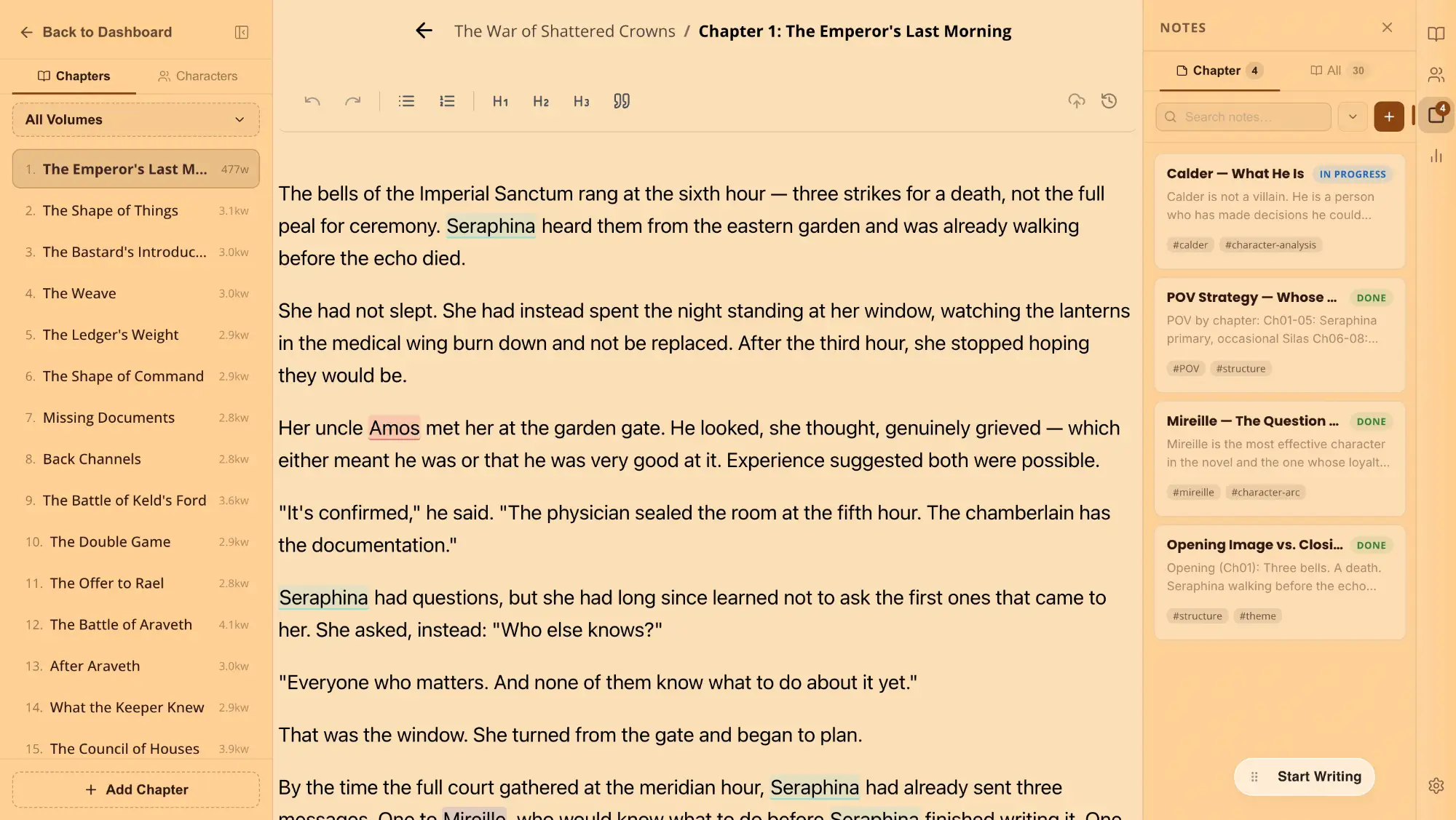
haracter profile and world notes in WriteO, right next to your manuscript
Building a Story Bible Mid-Draft
You are already 30,000 words in. You have no story bible. You just realized you need one.
Do not try to go back and read your whole manuscript from the beginning. That takes days and pulls you out of the momentum of writing. Here is a faster way:
Start With Main Characters Only
Write down everything you already know about each of them from memory. Name, appearance, what they want. This takes an hour and covers the characters where mistakes matter most. Check out our guide on
|
Write Forward, Log as You Go
Every time you write a new scene that introduces or changes something, add it to the bible right away. You are not reconstructing the past. You are capturing the present.
Spot Check Only When Something Feels Shaky
If you are not sure when two characters last interacted, search your manuscript for that specific thing. Fix it, add it to the bible, and move on.
Leave Background Characters for Later
Add them only when they reappear. If they never come back, you do not need a profile for them.
Within two weeks of writing this way, you will have a working bible without having stopped to go back through everything you already wrote.
How Writeo Handles This
Every section of a story bible has a home in Writeo, and all of it lives inside the same tool you use to write.
Character profiles sit alongside your manuscript. When you introduce a new character in chapter eight, you add them in the same session. Their profile tracks appearance, backstory, personality, and which chapters they appear in as you write.
The Character Relationship Visualizer maps every connection between your characters on an interactive graph. When a relationship shifts in chapter fifteen, you log it through the Evolve Relationship feature. You record the new relationship type, the intensity level, which chapter it happened in, and why. The Relationship Timeline stores the full history of that connection so you can find any moment of it in seconds.
World notes attach directly to your manuscript. Your timeline lives in the same project as your chapters. There is no switching apps, no separate document to remember to update.
Writeo comes with pre-built character profile templates so you are not building the same structure from scratch every time. You can also build your own. One template for main characters with every field you need. A shorter one for supporting characters. A quick one for background characters. Set each up once and apply it every time.
For series writers, you can keep multiple novels in Writeo with shared character and world information that carries across books.
The free tier covers two novels and fifty chapters. Start free at writeo.app.
One Last Thing
Brandon Sanderson does not hold the Stormlight Archive in his head. Sarah J. Maas does not remember every detail of every character across six ACOTAR books from memory.
They write it down. In a system. Updated consistently. That is the only reason those books stay consistent across thousands of pages and years of writing.
You do not need to be writing at that scale for the same principle to apply. A cast of ten characters across one novel is already more than memory handles reliably over a year of writing sessions.
Start small. A character list, a world rules section, a basic timeline. Open it every session. Update it before you close your laptop.